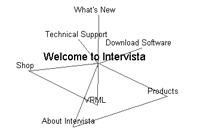
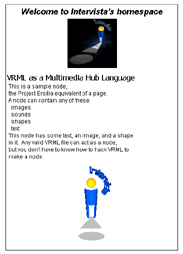
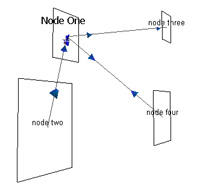
Visual XML is a way of describing websites and other structured information spaces in XML and publishing them in VRML. The images on the right are what a site, a page/node and links designed with the current VRML proto implementation look like. This whitepaper will describe how it works, some of the features, and some impacts and implications of three dimensional information spaces, including the benefits to end users. The terms information space, web space, and web site are used interchangeably in this paper, but all refer to structured information: nodes of information that are related or linked together. Examples of structured information spaces include presentations, many types of document, and websites.
The exact implementation of Visual XML has yet to be determined. The VRML could be created on the server side by a Perl script, or on the client side using ActiveX controls or Javabeans. VXML could be a standalone format (similar to RDF), or it could function as a 3D stylesheet. One of the main objectives of VXML is to give authors and designers an easy way to experiment with conveying information in 3D, using a simpler and more direct syntax than straight VRML.
Visual XML is intended to pave the way for the eventual replacement for HTML. It is intended to be a general front end for XML. The web has many problems, and lacks much of the functionality imagined by its conceptual but unimplemented predecessors like Vannevar Bush's Memex and Ted Nelson's Xanadu project. VXML addresses a subset of this missing functionality and brokenness with the current web:
- Relationships between nodes (web pages, data, or information) exist, are designed, and are implied, but users almost never see them and even if they could, they can't change them.
- General navigation problems: Web users generally have almost no idea how big a web site is, how much information is there, or what types of media are being used. They also have only rudimentary ideas of where they've been and where they can go.
- Totally representational and totally abstract worlds both have their problems. Mcubed combines the best of both.
- Collaborative document creation with current interfaces is basically impossible. Most people still print out pages and link in their changes with a red pen.
- Media integration on a 2D page hardly makes sense, when even existing hardware is capable of more. 2D pages are a medium to be integrated, not a medium for integration.
- It makes more sense to have 2D objects in an intelligently designed 3D space than to have 3D objects inside 2D windows.
- All the problems with HTML: It doesn't degrade well. It's exceeded its designed capacity. Writing software to deal with it is painful. It isn't extensible. XML is really attacking these problems; Mcubed is just a general way of displaying XML.
VXML offers benefits to end users of the information space. Most classical 3D visualizations have been used to display complex data, but VXML is designed to permit the display of something far simpler: relationships. This is accomplished by using the simple visual linking structures described in linkspace.
The VXML protos are 100% pure ISO standard VRML. VRML is backed by a consortium of more than 35 companies that have made the commitment to interoperability. The VXML protos have only been tested in Platinum technology's WorldView VRML browser, and they use some spec-compliant browser extensions currently available only in WorldView 2.1. More information on WorldView is available in References. The screenshots shown here are from working demos, which will be available on the web soon.
The rest of this whitepaper will talk about the details of how VXML works, including samples of VRML code and what the corresponding XML might look like. Non-technical readers may want to briefly scan these parts of the whitepaper and skip to the Impact and Future sections.